The Freedom to Roam: Responsible Trespassing, Rambling, and Sensible Pedestrian Urban Design

Shôn Ellerton, September 4, 2025
Walkers, ramblers, and outdoor recreationists enjoy the freedom to roam, but these freedoms are often under threat or simply failed to be integrated in our designs.
It was a gorgeous winter’s day in southern metro Adelaide. The low rays of the winter sun shining with golden splendour against the trees. The rolling hills covered with luxuriant green grass dotted with yellow clover flowers which, otherwise, would have been drought-ridden ‘teddy bear fur’ during the summer months. The gentle trickling sound of a small brook which, for most time of the year, would be dry as a bone.
This was in one of the many undeveloped unspoilt tracts of land between housing suburbs along the southern coast of Adelaide. The one I was walking on was between the large rolling suburb of Hallett Cove and the smaller hilly suburb of Marino. A railway line, connecting the two suburbs, ran in parallel separating me from the coastline along with the road, cycle path, and houses dotting the shore. I was on the ‘wild’ side rambling through the native bush and enjoying the greenery. However, there was a path of sorts which made it easy to trek through. Indeed, for anyone living in either Marino or Hallett Cove on this side of the railway, to make the trek between the two, this is, by far the most direct and scenic route.

Crossing private property with railway line fence on right-hand side
between Hallett Cove and Marino
Unfortunately, I came across a barbed-wire fence saying Private Property blocking my path. It wasn’t much of fence, but it was a fence just the same. Underneath there was a warning that trespassers may be prosecuted. I got this far and my destination was perhaps, say half a kilometre, further along. To go back and make the crossing at the nearest railway level crossing, and then, walk on the other side of the tracks to my destination would have made the journey three times longer.
Being a bit of rambler at heart, I wasn’t going to write my plans off immediately. The property belongs to a local quarry but the quarry pit itself was further inland over the brow of the hill away from the sea, so I wouldn’t think it too much of an issue in terms of common sense. There was certainly no evidence of any quarrying activity where I stood, especially being a mere few metres or so from the railway boundary. I thought, perhaps, that there would be a corridor between the railway line and the land belonging to the quarry, so I walked along a makeshift path along the quarry fence towards the railway.
Sadly, there was no corridor for public access.
The fence along the railway boundary was tall and kept in good condition whilst the fence along the quarry was low and unkempt. Indeed, there was an unofficial opening made by, I assume, other disenfranchised ramblers having their way blocked by the quarry owner.
Now, I would never encourage anyone to trespass on fenced-off metro railway land with frequent high-speed trains because, not only is it potentially dangerous, you have a high chance of getting caught and prosecuted. Railways enjoy quite powerful enforcement legislation and, generally, for good reason. As for large tracts of private property which looks wild and unkempt, it’s generally unlikely that anyone would care, but one must still exercise judgment and caution. The biggest danger of trespassing on private property is not of being caught, but of being attacked by guard dogs. As this fence had great big gaping holes along its way, I doubt that any dog would be prowling here. No attempt to repair the fence looks like it had ever been made or even bothered with. Also, the evidence that many others had already trailblazed their way through to reach the other side proved a bit of a point that blocking this section of land is a massive and unnecessary inconvenience to walkers.
There are other factors that must be determined whether it may or may not be a good idea to trespass.
Is the land genuinely dangerous?
I remember walking the forests along the recently dismantled East and West German border in the Harz Mountains during the early 1990s. Despite the warning signs, you could walk across the abandoned stretch of no-man’s land but, considering that the land between the two was dotted with mines which have yet to be removed, it would be a very bad idea to do so. Other examples of dangerous land include geothermal basins, like that found in Yellowstone, and deceptively dangerous peat bogs in which, what appears to be solid ground, is actually a thin layer of soil floating on deep pockets of water.
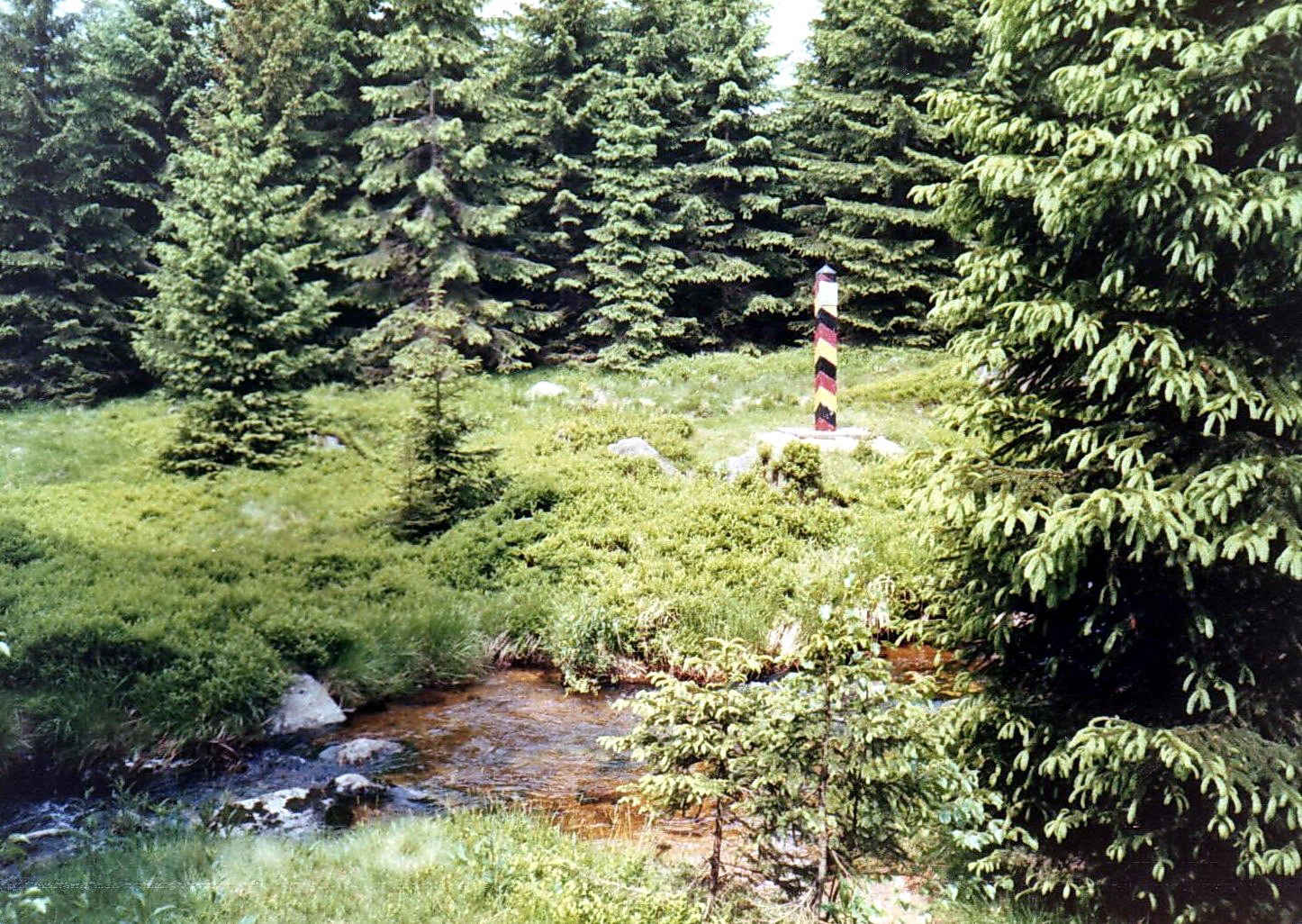
Approaching East German border before 1989
If the land belongs to the military or Department of Defence, that is a sure sign that crossing it is a very bad idea. But people do, and people get caught, or worse, in some situations, they just disappear. In any case, I would expect ample warning signs and a well-maintained fence around such tracts of land. At least in areas close to urban living.
Another factor is land that is of cultural significance to indigenous people. In other words, those pieces of land that non-indigenous people are not allowed to venture into. Australia is plagued by such pieces of land and wrongly so. I don’t see anything more special or privileged about indigenous people than the rest of Australian society, so tend to ignore such ridiculous and virtue-signalling rules.
Making my decision, I cross the short stretch of land keeping on the path which keeps close to the fence cordoning off the railway line.
This is one of many examples of, what I consider, to be very poor town planning for the facilitation of human traffic. And frankly, it irritates me immensely when I come across these.
Any council with an inkling of logical foresight would have created a public corridor between the land belonging to the railway and the land belonging to the quarry. It need only be a few metres in width or less, but at least it would allow walkers to pass unimpeded of any thought that what they are doing is wrong. And, let’s face it, most Australians are incredibly law abiding. If they were told that they’re not allowed to wear yellow socks on Sunday, they wouldn’t.
And this is the thing. Determined walkers and ramblers alike will find a way around something even if it means breaking an occasional rule or two. I certainly wouldn’t damage a fence to do so, but clearly, someone else had done it to probably make a point of it. Ramblers are known for their defiant behaviour.
The Freedom to Roam is a complex subject and varies from country to country. Most European nations, for example, have freedom to roam, even on private tracts of land. It doesn’t mean all private land, but rather, large areas of unused, undeveloped land in rural locations.
In the UK, it is known as Ramblers Rights and can extend to public paths that have existed before being developed into dense housing projects because the planners failed to include the right-of-way or simply chose to ignore it on the pretence that once bought by the unsuspecting buyer, the problem would simply ‘go away’ and be someone else’s. There have been many cases of very unhappy house owners in which certain ramblers, just to make a point, jump their fences, invade their privacy, walk across the garden sometimes causing damage, and jump across to the other side. This behaviour is both reprehensible and immoral, not to be confused with those simply wishing to cross a big tract of open land which is privately owned.
The United States is a little different because property rights extends the right to exclude others and, coupled with the fact that laws are somewhat more lax with respect to gun ownership and laws of self-defence, one must be very careful with trespassing on private land there. I would most certainly think twice, especially if there are signs warning that trespassers will be shot.
Unfortunately, excessive litigation has made it almost compulsory for land owners to put up warning signs for trespassers, although, in reality, it is not usually effective as a means of defence should something happen to the trespasser. For example, there have been several cases in Australia in which trespassers on private property have sued land owners because they hurt themselves on something lying around on the property. Perhaps, a bit of barbed wire, a hidden pit in the ground, or even something which can simply be a trip hazard.
Australians and many Europeans have been largely stripped of rights to carry arms, including certain knives, and to no longer enjoy the protection of, what is known as, Castle Law or Castle Doctrine, in which home or land owners have the right to use reasonable force to prevent an attack or intrusion on their land. Although the Castle Doctrine may still be technically in place, most of these countries require a high degree of proof that the owner was imminently under serious threat. Unfortunately, the victim tends to be the land owner because possessing most weapons is illegal, and the law will find it far easier to prosecute on weapons possession rather than try to prove if the land owner was in eminent threat of being attacked. In Australia, the UK, and most countries of western Europe, law-abiding citizens have been essentially rendered defenceless against criminal perpetrators, who seem to always find a way to procure illegal weapons via the black market or through other nefarious sources.
As an aside, in the state of Victoria in Australia, currently being governed by a wacky, somewhat authoritarian, government has recently imposed a machete amnesty program costing the taxpayer a staggering 13 million Australian dollars whereby only forty secured bins have been placed throughout the state for people to surrender their machetes. Failing to do so before the end of November 2025 may incur a fine of up to $47,000 Australian dollars or a two-year sentence in jail. And yes, that works out to be, on average, $330,000 per bin!
And to top it off, owning a bulletproof vest in Australia is illegal without an official permit because it is, bizarrely, classified as a weapon. So, one can’t even legally protect themselves from gunfire by some crazy madman with a gun. However, because of Australia’s slow transition into becoming a very sketchy police state as Britain has already become, perhaps the law is in place because the police are unable to shoot you dead if you try to run away from them.
Returning on the subject of poor town planning with respect to the movement of people on foot, look no further on inadequate access routes for pedestrians in new housing developments. Fuelled by greed I expect, developers will take every available space for housing blocks with little or no regard for pedestrian routes. For example, I often come across cul-de-sacs in newer neighbourhoods on the hope of finding a thoroughfare to get to the other side only to have my progress impeded by a wall of housing thus forcing me to walk an extra twenty minutes just to reach the other side. For those living near the end of a cul-de-sac with no pedestrian access to amenities such as shops and restaurants on the other side, must find this incredibly inconvenient thus necessitating to driving the car every time.
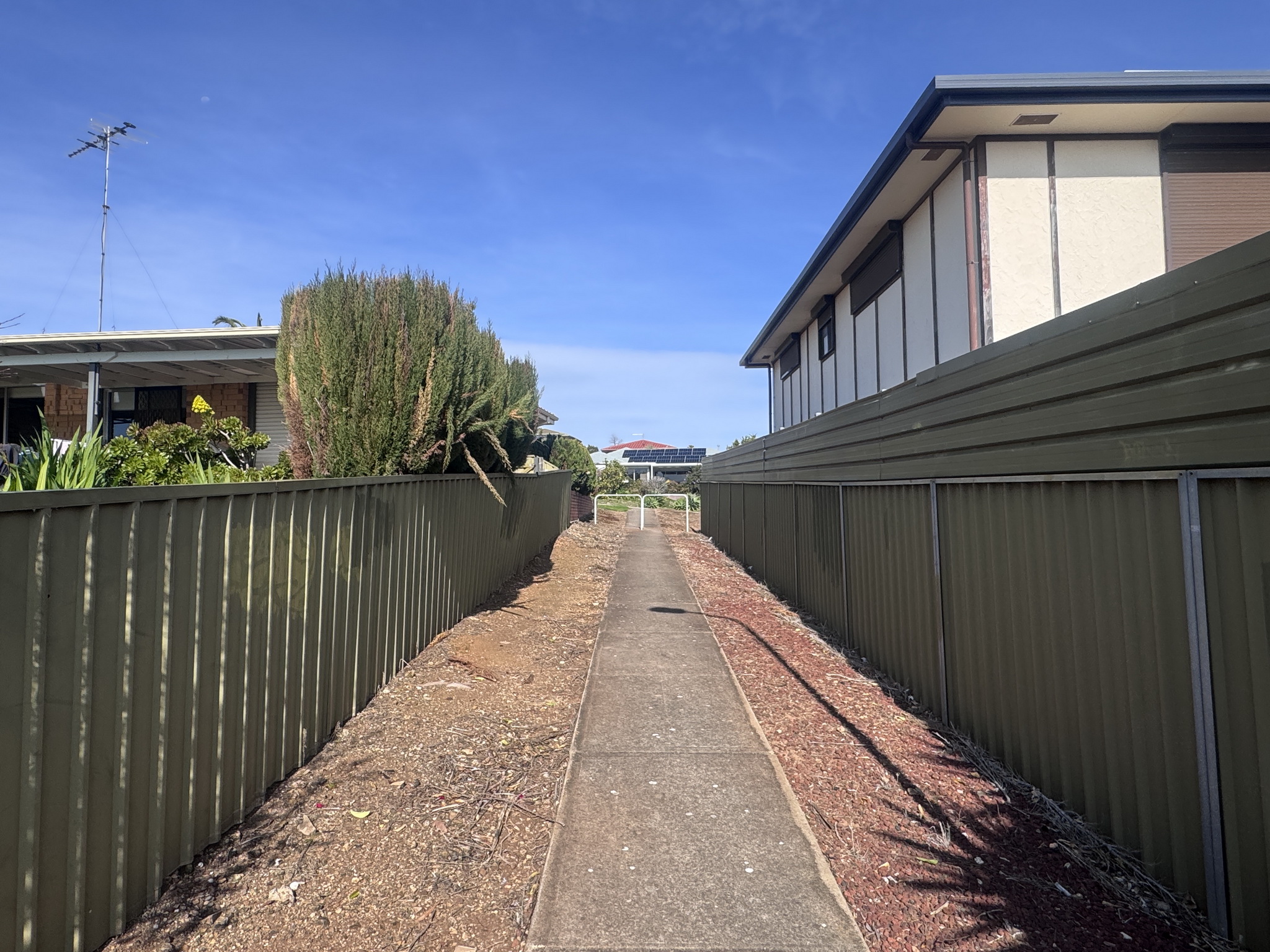
Pedestrian thoroughfare between adjoining streets in a south metro Adelaide suburb
Urban planners often fail to take into account human psychology. They live in this little Utopian world where everything looks neat and tidy and everything is perfectly in its place. I’ve come across many examples of very inconvenient pedestrian crossings on busy intersections and roundabouts. Beautiful rows of flowers separated from the road pavement by a little white hooped metal barrier on the corners of an intersection or roundabout. However, at every single one of these corners, there is an unsightly worn-out dirt path through a bed of flowers with, often, portions of the little fence knocked over or removed, because of pedestrians defiantly wishing to cross the intersection without having to walk an additional thirty or more metres to an official crossing.
These kind of urban planners seem incapable of thinking out of the box and assume that all pedestrians will conform to their design and take the official crossing. Human nature is such that we naturally tend to take the shortest path possible, especially if they have to get somewhere on time or carrying a heavy load. Those occasional urban planners who are more astute in their way of thinking have designed this flaw out by paving the area at the corner and removing a portion of the fence but still encouraging pedestrians to use the safer official route by installing zebra or pelican crossings. Most people, especially those with children, will tend to use the safer route, but there will always be those who will take the shortcut. So why design a layout which will eventually be damaged?
Sometimes, urban planners have been responsible for unexpected tragic accidents despite good intentions to make the pedestrian environment safer.
One of the most common examples is the erection of fence barriers separating the road pavement from the pedestrian sidewalks in busy city centres. The obvious reason for building these barriers is to prevent pedestrians from straying on the road pavement. Unfortunately, as cited earlier, urban planners tend to fail miserably when presented with the problems of human psychology. Us humans, at some point in our day-to-day lives, may make an ill-informed decision to cross at an unsafe point along a busy road to get somewhere on time. It is, at these moments, that accidents are more likely to happen.
Obtaining statistical figures for the number of people who get crushed between pavement barriers and vehicles whilst walking along the wrong side of the barrier is elusive but these kind of accidents certainly happen. I’ve seen people unsafely run across the road and then find they are trapped between the road and the sidewalk by a fence in the way and press up hard against the fence hoping that a bus doesn’t make mincemeat of them. One could argue that they crossed the road illegally and ‘deserve’ to get run over, but I doubt that that reasoning would hold up very well in a court of law.
To end this discussion on rambling and the freedom to roam, let’s discuss access to national land.
In the United States, there was an attempt to pass a bill to sell off millions of acres of public land via the Senate Reconciliation Bill, a small part of the so-called Big Beautiful Bill. A map can be found online showing areas of green and orange in which the green areas signify already protected national forest and parks and the orange areas, proposed tracts of land which are eligible for sale.

Orange areas showing unpopular sell-off of public land in the United States
Huge areas of land totalling around three million acres of so, marked in orange, were proposed by this bill to make it available for private sale. Much of this land is wild, beautiful, desolate, and often, teeming with wildlife undisturbed by human intervention. It is also an adventurer’s paradise who can freely pass and explore on the provision that they don’t leave litter, damage the environment, and just be responsible for the well-keeping of the land.
However, there was so much opposition to selling off the public land by both Democrats and Republicans, that the bill was repealed during late June 2025. Which is, of course, a glorious result.
Some countries, a prime example being Australia, have a two-tiered system in which only indigenous people can access certain areas of land. In my opinion, all Australians should be granted equal rights regardless of their generational background. Uluru, or Ayers Rock, may be classified as a national park of Australia, but the reality is not so. It was sold off by the government to the local indigenous community making it a private tourist attraction. On the misguided basis of cultural sensitivity, taking photos around many areas of the rock is not allowed, however, you are allowed to if you pay for the privilege. Money talks.
The freedom to roam national land is such an important facet of enjoying our outdoors and it is vital that everyone put up a fight against greedy corporate interests such as that outlined in that proposed sell-off of public land in the United States or against cultural heritage initiatives, like in Australia, inspired by virtue-signalling politicians preventing anyone with the wrong generational background to enjoy roaming national land.
It is also to call upon urban planners and councils to ensure that the freedom of pedestrian movement is not grossly unhindered by putting into place, sensible urban design policies. Naturally, we don’t want to allow anyone to randomly cross somebody’s private abode at a whim, but we also don’t want to create urban environments and neighbourhoods whereby a pedestrian would have to take an exasperatingly long detour just to reach a short distance as the crow flies. This is why it is prudent for urban developers to create a sufficient number of public thoroughfares.
All of us cherish the idea of being able to move freely and it is within our human psyche to have that freedom in place but it is also embedded in our behaviour to take shortcuts and take the most convenient path. Obviously, we must have private spaces and we should make reasonable efforts to discourage the public to wander into dangerous places. However, we should also be sensible with how we design our urban spaces to make it more convenient for pedestrians, walkers, and ramblers alike. We should be encouraging more people to walk rather than force them into cars, which is particularly a scourge within American commercial suburbia where everyone seems to need a car to access anything. Our public land should be made available to all and not be subject to government sell-off for private investors or reserved only for a certain group of people based on their ancestral background.
Despite certain protections for public thoroughfare in tidal waters around shorelines, there seems to be an increasing number of beaches and shorelines which are turning private or inaccessible to the public.
This is unacceptable so sometimes we sometimes tend to resort to ‘responsible’ trespassing in which we formulate our own personal judgments whether it is right or wrong to trespass a piece of land in order to get to where you need to in a convenient way.
Finally, it’s prudent to point out that the wealthy and elite among human society tends to have access to far more land in general, public or private.
Publicly, because they are able to travel further to access the land. And privately, because they can afford to pay for golf memberships, private fishing and hunting grounds, and other private land in which expensive permits are required. I’m not against golfing as a sport, however, I do take issue when grey, dense, and sprawling urban spaces with little or no parkland have numerous lush and green private golf courses in which only the rich can afford.
We could do so much better.