What Makes the World of Labyrinths, Mazes, Portals, and Liminal Spaces so Frightening

Shôn Ellerton, May 27, 2026
In this piece, I explore the world of labyrinths, liminal spaces, and portals and explain why they are often such frightening places.
Within the quiet and muffled creakiness of an old house in desperate need of modernising, a woman sits alone on a well-worn padded armchair reading a book with the aid of a dull orange light given off by an ancient table lamp near to her left arm. The room she sits in is generous in size, the light barely reaching the walls bedecked with hideous yellow-patterned wallpaper.
She inherited this house and had moved in with her small collection of possessions that she had while renting a small bedsit down the road in the middle of a French town.
She hears something behind the walls. Perhaps, a scurrying of house mice or rusty pipes in dire need of attention, or some other unwanted denizen of the wilderness looking for a refuge to stay the night. After a series of uneasy nights living with this phenomenon, she decides to investigate.
She pries away the wallpaper revealing an older layer of wallpaper comprising of hideous blotchy Rorschach images that resemble silhouettes of moth-like creatures with malignant eyes. The curiosity getting the better of her, she continues on to dismantle the wall to reveal a space separating that wall with the next.

From Beyond The Walls French TV series poster with creepy Rorschach wallpaper
Just wide enough for her to fit in and armed with a torch, she walks between the walls. She approaches a door at the end, opens it, and ends up in a dark room with old furniture along with two or more doors leading away to other spaces. A physical impossibility, as she enters into another world. She opens one and enters yet more rooms, and sometimes, long corridors leading to a seemingly endless number of rooms, all with old furniture much in the style of the 1920s.
There are no windows to the outside world anywhere and she is hopelessly lost in a very large maze of rooms and hallways. She cannot retrace her steps to the opening in the wall because the door she just went through leads to another room with antique furniture. She meets, by chance, a gentleman, who has been held captive in this space for years surviving off food somehow being replenished by unexplained circumstances. She learns from the gentleman that being quiet is essential because there are a host of unwholesome, but not particularly clever, creatures that are not quite human that enjoy feasting on captives unfortunate enough to be discovered.
What I described above comes from a short 2016 French TV series entitled Au-delà des Murs, or in English, Beyond The Walls.
In my opinion, this relatively unknown, but brilliantly-done three-part TV series is one of the best done, and one of the creepiest, pieces of horror and fantasy that I came across. It resembles an impossible transcendent space that cannot exist in the same reality as in the real world, much like entering the closet in the Chronicles of Narnia or entering Dr Who’s Tardis. More recently, the Backrooms phenomenon created by YouTuber, Kane Parsons, in 2019, took a similar idea of such an impossible space that shouldn’t exist.
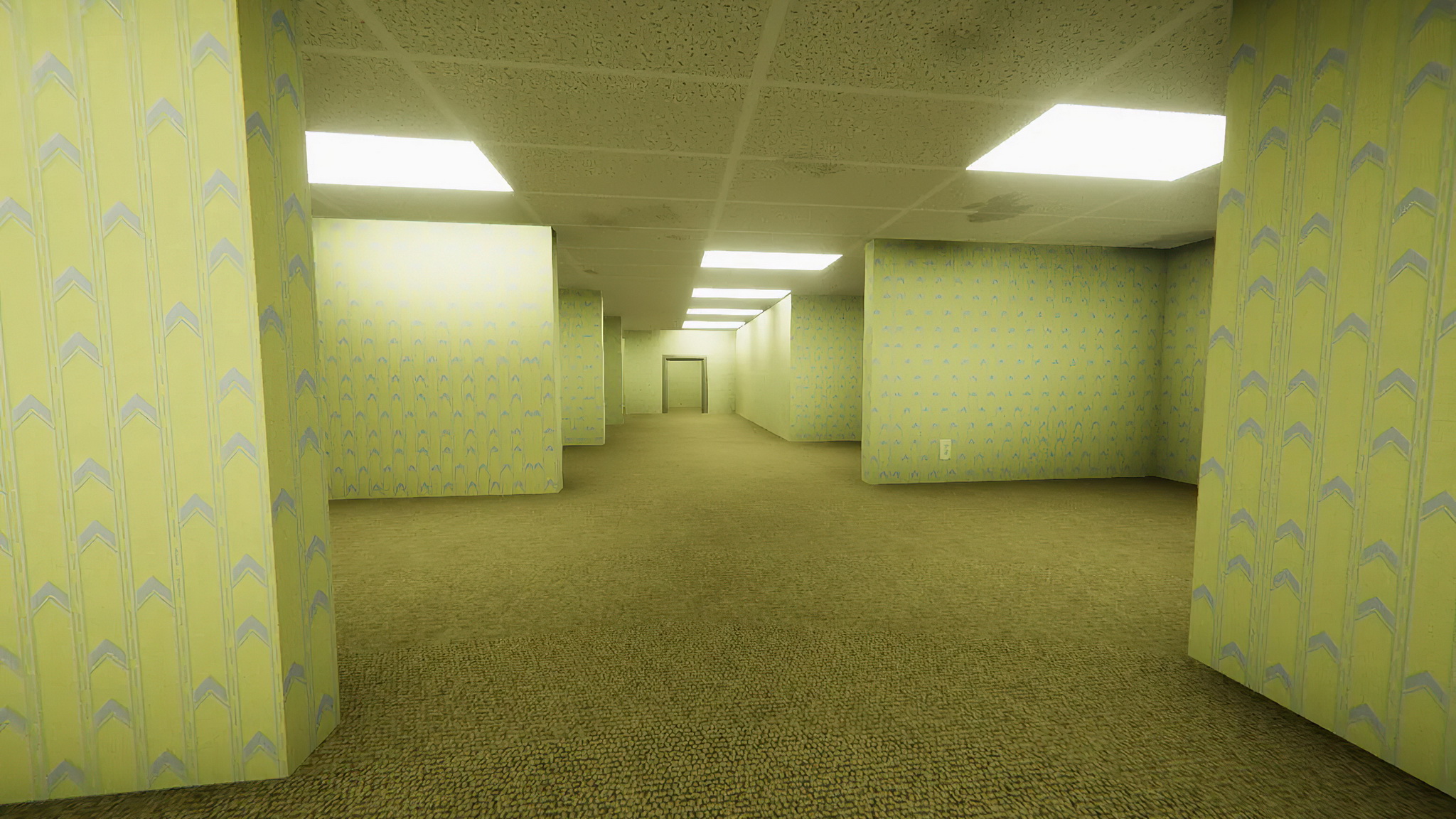
One of Kane Parson’s hellish Backrooms liminal spaces
In the literature world, we have The House of Leaves, written by Mark Danielewski, which portrays a house with an opening on the second floor leading to endless corridors in pitch black darkness with huge dimensions that far exceed the outside dimensions of the actual house. The explorers in the book walk for hours and hours coming across vast internal spaces with massive spiral staircases descending to unknown depths.
Another example includes the well-known David Lynch Twin Peaks TV horror drama series in which the liminal space of the so-called Black Lodge, a fearfully scary place in which you must confront your fears, can be accessed through a circle of sycamore trees during certain nights of the year when the Moon is aligned in a certain way.

On entering the Black Lodge in David Lynch’s Twin Peaks TV series
We have the Phantasm science fiction and horror movie franchise featuring the ominous Tall Man, in the guise of a funeral undertaker. He is in possession with a couple of floating steel balls armed with retractable blades as his choice of gruesome weapon. His duty is to capture humans, process them, and transport them to another world as slaves to work in mines and quarries in a hostile world with stronger gravity amidst a continuous windy storm of red dust. The portal consists of a pair of metallic columns that ominously hum like low-resonating tuning forks.

Nightmarish world over the threshold of the ‘tuning forks’ in Phantasm
We have the TV series, Stranger Things and its Upside Down, a sinister and parallel world filled with grotesque creatures which was opened up because of nefarious secret government activity attempting to open up gateways to other dimensions within a small town in the American heartland.

The sinister Upside Down lies just beneath in Stranger Things
In a very similar vein, we have Stephen King’s The Mist, a short story which also spawned a great horror movie about a thick bank of fog spreading from a power plant or some sort of military establishment from the opposite banks of a large lake engulfing and terrorising a small town with overgrown hideous spider and insect-like creatures that kill anything in their paths.

Artist’s depiction of creatures in Stephen King’s The Mist
And finally, we have the Hellraiser franchise of movies with the infamous musical toy box puzzle which, if opened, thrusts the foolish venturer into a terrifying personal world of Hell. The second movie depicts one of the scariest and most cruel labyrinths ever shown on celluloid.

The Leviathan floats over the Hell labyrinth in Hellraiser 2: Hellbound
Apart from The Mist, these are liminal spaces that, for many of us including me, are terrifying in so many ways. These are spaces that cannot exist in our physical world. Where dimensions are otherworldly and nonsensical and shouldn’t fit in the parent structure to which they belong. The Doctor Who Tardis, the blue police box, is my first experience of this as a kid, although this isn’t scary but rather, a cool concept and one I wish I had for my kitchen pantry and garage.
All this considered, the example for the Phantasm and Hellraiser movie franchises are more of a teleportation device leading to another world, the former being physical and the latter metaphysical, but they do represent a frightening concept of a portal in which crossing the threshold may be a one-way ticket to a place you don’t want to be.
Some of these liminal spaces are accessed through portals, and some, as in the case of the Backrooms or in Beyond the Walls, the victim just stumbles into without realising it. Incidentally, I am a spooked-out fan of the Backrooms concept in which someone can inadvertently ‘no-clip’, or suddenly, materialise into a world of endless office spaces, grey suburbia, or other lonely, endless, and eery places dotted with the occasional nasty entity lurking somewhere.
Strongly interconnected with the fear of portals and subliminal spaces is the fear of being in a maze or labyrinth. Indeed, being stuck in a seemingly endless world of rooms and hallways between a pair of walls in an old house is a fine example of being held captive in a labyrinth and a liminal space.
Countless movies, many of them I enjoy watching, feature terrifying situations of being in a labyrinthine space not knowing what’s going to be around the next corner. The Shining, with its endless and empty hotel corridors, when, on occasion, turning around the next corner, one may suddenly confront two pale and ghostly-looking girls holding hands in uncanny symmetry dead centre down the corridor staring right at you.

One of the creepiest visions in movie history in Stanley Kubrick’s The Shining
The Cube, in which captives in a twisted military experiment negotiate a three-dimensional cube structure with many rooms designed with booby traps designed to kill in quite unique and original ways.

The booby-trapped cube maze in the low-budget but highly-effective movie, The Cube
The Maze Runner, in which captive teenagers are caught in a maze of high stone walls which change shape and after dark, nasty creatures come out to prey.

The ever-shifting maze containing creatures in The Maze Runner
And Vivarium, a nightmarish endless swathe of grey suburban houses where there is no escape.

No escape from this suburban hell in The Vivarium
Why are mazes and labyrinths, especially when combined with liminal spaces, are so frightening?
The terrors are two-fold and equally terrifying.
One. The fear of never finding a way out.
And Two. The obvious fear of being pounced upon.
Within a labyrinth or maze, you could be literally inches away from something atrocious and horrible and yet, not knowing it is there. Is it behind the wall, or just around the corner? Also, in a maze, there is no obvious place to hide. Something is going to find you sooner or later and the best you can do is press on and try to find an exit.
The concept of being fearful of labyrinths is certainly an ancient one.
My first knowledge of dangerous labyrinths might have been in my childhood when learning of the ancient Greek mythology of containing the Minotaur beast within a labyrinth built by Daedalus for King Minos. Somehow or another, I had recurring nightmares of wandering around dark stony corridors and stumbling upon Greek mythological nasties including Gorgons with snakes in their hair and other infernal half-man half-beast creatures.
Another feature that can really haunt the supple minds of young people, is the carnival funhouse. Seemingly innocent, I think they are, perhaps, some of the most frightening experiences someone with a timid disposition can experience. Some funhouses feature a sit-down ride, many of which, aren’t particularly scary or notable. However, some of the walkthrough funhouses have taken scary to new levels where customers often have to fill in a disclaimer form, for fear of inducing a heart attack, before entering. Live actors often feature in these extreme funhouses, and believe me, some of them are too convincing.
To this day, I have the occasional and dreadfully uncomfortable dream of navigating through some sort of labyrinth with lots of confined spaces, dead ends, and little rooms, each featuring something quite horrible and nasty. For example, demonic toddlers armed with chainsaws, giant venomous spiders, and spring-loaded death traps much like that in the beginning of the movie, The Raiders Of The Lost Ark.

Iconic scene in Raiders of the Lost Ark before the booby trap gets sprung
Despite being a lucid dreamer on a frequent basis, with the reassuring knowledge that I can get out of any dream if I wanted, for some odd reason, I feel the need to run the gauntlet of the labyrinth as if I’m playing some souped-up devil video game. I know that I’m going to run into these monsters and creatures to the point that I know precisely where they are. The reason being, is that, being a lucid dreamer, I remember coming back to these places, and time and again, something propels me to enter and complete the labyrinthine funhouse of horror.
In my late twenties and early 30s, and still to this day to a point, I am intrigued with those first person shooter video games which feature these dark and gloomy mazelike spaces. I would have to say that Doom 3, from 2004, and F.E.A.R. from 2005, represent some of the creepiest spaces I’ve encountered in the world of video games. Although, not having researched into video games for quite some time, I’m sure there are some truly frightening releases that have come out since then. Being alone in a dark house with headphones on made the experience that much more visceral.

Doom 3 video game with its broody and visceral atmosphere
In all, what makes mazes, liminal spaces, portals, and labyrinths so frightening is their allure and appeal. They attract so many types of people, especially those who enjoy urban exploration, as I once did. Although, I still do now but more cautious and hesitant after growing somewhat wiser. In my younger days, if I saw a gate to an underground mine that had been left unlocked or ajar, I would run back home to arm myself with a torch and provisions and run back to the mine to explore it, despite its obvious dangers. Not sure I would so these days, but the thought of coming across some ancient or unknown artifact in something that resembled the Mines of Moria would be so compelling if it wasn’t for the fact that the biggest danger in these places are other people.
Which brings me finally to what may be possibly one of the most dangerous real-life mazes on the planet.
The so-called Mines of Paris in which hundreds of kilometres of tunnels, many of them cut off and unexplored, are located under the streets of Paris. A small portion can be freely explored as a tourist in the human-boned-filled Paris Catacombs, which is a safe place to wander around because there is a trail, lighting, and, along the way, there are locked iron gates off to the sides to prevent anyone from erringly going off the beaten path and into the mines. Indeed, standing at the gate and peering through it into the silent darkness, save for the dripping water, is both sobering and reflective.

Picture I took in the Paris Catacombs some years ago
But worse, the Mines of Paris have a community of undesirables which are untouched by civilisation above the ground. The public are forbidden of going down there and for good reason. No one is going to rescue you if you’re lost or, heaven forbid, attacked by the denizens who live down there. The police certainly won’t go down there. Paris sewerage workers, from time to time, cross paths with those who live down there and are always conscious of ensuring that no one strays away from the group and gets lost. I came across a YouTube video of someone being escorted into the mines at great danger to himself and the host who knew how to navigate them.
However, we are straying towards the topic of urban exploration which warrants a separate piece of its own.
We, as humans, possess the innate curiosity of the unknown, some more than others. The motives may vary, from treasure hunting, to simply wanting to find out what lies on the other side. The adventure is often a sublime experience to many but there also lies the risk of venturing into a place one can’t retrace their steps back to where they come from.
Which makes the world of labyrinths, mazes, portals, and liminal spaces so fascinating and yet so frightfully scary and dangerous.