The Councils Are to Blame for the Increase in Fly Tipping
Shôn Ellerton, November 3, 2025
If it becomes so expensive, inconvenient and difficult to get rid of waste, then expect to see an increase in fly tipping.
The stupidity and arrogance of local governments, brainless councils, and idiotic mayors staggers me in disbelief at the best of times.
Here are a few actual examples, some of which I’ve personally come across.
Wanting to ban natural gas to all new homes because it might trigger asthma sufferers. – Sydney, Australia
Wanting to ban bonfires for burning off green waste on your property in rural towns. Even during times when the risk of fire isn’t high. – Northern Areas Council, South Australia.
Wanting to ban yucca plants being too close to the public pavement should someone might prick themselves whilst walking next to them. – Marion Council, South Australia
Wanting to ban shopkeepers in a town in England for adding a little ramp for wheelchair-bound people to use because it will destroy the heritage character of the town. – Ludlow, England
Prohibiting the use of drones by the general public but okay for councils to use drones to monitor what people are doing to their properties. – Australia-wide
Forcing rural hotel publicans, desperate to keep their businesses going, to remove their advertising signs on private property even after been given consent by the owner. – Northern Areas Council, South Australia
And incredibly so, wanting to ban the use of swear words in public places. – Thanet, England
There are so many examples but it begs the question. What sort of people are these who run for Council and make up such decisions, many of which are borderline insane.
Ultimately, we have to look in the mirror.
I guess the more intelligent of us in society probably have better jobs and careers and would never contemplate raising their hands to be an elected local government official. It simply leaves an easy vacancy for some dimwit who put up their hands to run for Council, after which, it’s too late and they’re pandering to the most stupid in society and, lo and behold, they’ve suddenly got the upper hand with near-unchecked power under their control.
I am, of course, generalising here.
Paradoxically, the most intelligent of us can never become leaders. Albert Pike, a famous American writer during the late nineteenth century, once said,
‘The acutest thinkers rarely succeed in becoming leaders of men.’
How right he was!
The acutest of thinkers are, sadly, not smart enough to put their hands up for public office, leaving plenty of vacancies for nincompoops, many of which, make up asinine rules to make most people’s life more difficult or even a misery.
In this piece, we will talk about local council’s obsession to make it as difficult as possible for people to get rid of their waste. And what is the inevitable result every single time?
Fly tipping!
The act of illegally disposing rubbish much of which ends up in our pristine countryside. I remember one of the most reprehensible acts my father used to do. Whilst driving, he would remark how beautiful the countryside is, and after consuming a snack like a chocolate bar or packet of crisps, would open the window and, without a moment’s thought, chuck the empty wrapper outside!
I first became aware of the increase in fly tipping back during the 90s in Britain, a period of time in which there was a noted increase in awareness of what to do with the all the piling rubbish across the nation. Greenies were protesting about the levels of waste and somehow or another, they got their way. Councils came up with smaller and smaller bin sizes. Not only that, some councils reduced their collection times from weekly to fortnightly resulting in street after street of overloaded bins, some of them overflowing with organic waste putrefying on the ground creating that typical third-world stench.
The councils did absolutely nothing nor did they care that their once clean streets had become litter-strewn hell holes. The foulness just got worse and worse.
Eventually, something had to give, and some of these councils started to issue warnings and fines to those who had overflowing bins or even bins which had been left out on the street for too long when it wasn’t the time for the garbage people to collect them.
Generally, people are resourceful, and when they’re forced into absurd situations like not being able to rely on their own councils, their own councils funded by the residents themselves, they resort to other means.
And that, just so, happened to quite an extent during 90s Britain. I remember driving countless road trips in the countryside only to find endless rows of rubbish bags just left out to rot on the side of the road.
It became such a problem that councils had to reverse their policies and re-enact the original rubbish collection quota policies which had previously worked, albeit marginally.
Unfortunately, mistakes made by inept councils are seldom acknowledged by other councils thinking of doing the same. Like governments across the world, they don’t learn lessons from mistakes made by others and think they can do successfully what others have failed. It’s a sick joke.
Australia, over successive years and slowly much like a frog in slowly warming water, has made it progressively difficult to get rid of practically anything.
Again, the environmental greenies and safety ‘Karens and Kevins’ got their oars stuck into local government policies on how to get rid of waste.
Take, for example, those plots of land in the countryside which require a considerable upkeep in maintenance to keep the weeds, trees, and other plants at bay and from overgrowing. Many Australian councils in rural settings have now prohibited the use of bonfires to burn away green waste, and in its place, they have provided a little green bin which you can fill with the green waste instead. Moreover, it is only emptied once a fortnight, and in some councils, once a month!
This is insane.
Anyone who owns a quarter acre of land, a fairly standard-sized block of land in regional Australia, with modest greenery knows that there is no way you’d be able to clear away green waste by solely using the official provided green bin. Regional and rural Australians, being in general, quite tightly knit community-wise and not quite as conformist to local politicians as the city folk are, tend to brazenly buck these impractical rules and burn it anyway despite the threat of being fined.
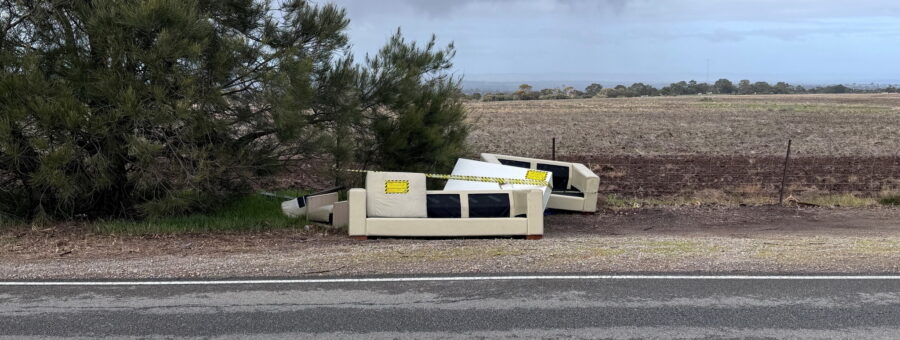
In metro Adelaide, I’ve seen a significant increase of unwanted household items simply left on the side of the road. Mattresses, sofas, bathroom vanities, car tyres, building materials, kitchen cupboards, paint pots, and countless other things no longer wanted.
The Council’s response?
Slap a big yellow sign on it marking it as an illegal dump site and to say that they are investigating the offence carrying a maximum penalty of $5000.
Good luck with that.
Eventually, the Council has to remove the rubbish at an inflated cost funded by us, the taxpayer.
In my neighbourhood, the council allows two tip tickets a year. With each ticket, you have a choice of taking a trailer-load of rubbish to the local tip or they can pick up one cubic metre of waste by booking in advance and leaving it on the kerbside.
For those with trailers, it’s best to opt for the former option because councils are extremely picky on what they pick from the kerbside. For example, my council refuses to accept anything to do with building materials and anything associated with demolition works. This includes bathroom vanities and old kitchen cupboards. I once left an old vanity unit outside with sink and cupboard and the council left a note that it wouldn’t accept it. I was also not re-imbursed with another tip ticket either. I ended up demolishing it in pieces and stuffing it in the regular bin out of protest.
Old car tyres are problematic and you often see them lying around in the countryside. They are dastardly difficult to get rid of legally at no charge. No councils will accept them as part of their tip service and dump sites charge high fees in doing so. Under normal circumstances, when you buy a tyre from a tyre service shop, the fee includes the disposal fee, and the shop should accept the worn-out tyre free of charge for disposal. It doesn’t always happen and when that happens, getting rid of tyres is expensive.
Used car tyres are exceptionally difficult to destroy. I’ve tried various tools from industrial shears to reciprocating saws, and each time, it destroys the blade in no time flat. The composition of today’s tyres are meshed with steel and other alloys making them not only nearly-impossible to destroy but essentially useless for recycling.
Before metal was added to car tyres, a particularly great use for worn out ones was to chop them up in pieces and mix them in thick rubber-based paint to make non-slip surfaces. I once did this with my father to coat a deck of a fishing trawler mixing up chopped bits of old racing tyres with a rubber-based paint called Deckaplex. Unfortunately, tyres with metal in it make this sort of recycling very difficult and extracting the metal from the rubber is a costly process.
Many people who want to get rid of car tyres without paying for disposal charges simply drive into the middle of nowhere and leave them there. The evidence is not difficult to find. The same goes for used paint pots and even old bits of asbestos.
Generally, when authorities like local councils and state governments make things more difficult, people resort to ingenuity even if it resorts to doing something illegally. There is a limit to people’s patience when the number of ridiculous restrictions and policies are put in place. Most people find ways around them, but still, our clueless councils don’t see through this, and in response, simply jack up the rates so everyone is punished.
If councils make it expensive and difficult to dispose of unwanted items which don’t fit neatly into the ever-decreasing acceptable categories of waste which they will accept, fly tipping will just continue to grow.