Infant Intellectualisation Using the Chair of Concentration

Shôn Ellerton, April 1, 2025
Unearthing a forgotten technique to accelerate knowledge ingestion into young infants between the age of 4 to 8 months.
Apart from learning through traditional means, is there a way to inject intelligence into infants?
It’s a question that many have sought an answer sparking off various ways through experimentation to find it. For example, placing a tape recording under a child’s pillow to tap into the subconscious mind or listening to Mozart. Not surprisingly, there is no research that has proved any success with these techniques and, up to now, no one has found the silver bullet to the problem.
However, there was an experiment that took place in the early 60s at the highly secretive Zardoz Industries in the United Kingdom. Little is known about the organisation save that it was probably named after Baum’s classic book, The Wizard of Oz, in which control can be mustered centrally through a significant vortex-like entity.
A new finding took place during the summer of 2022 in which a group of Oxford students came across a peculiar book titled The Chair of Concentration by Zardoz Industries hidden amongst the vast array of book shelves in the Bodleian Old Library containing blueprints of a child’s stroller. It was undoubtedly very odd indeed. It included engineer’s sketches of an ordinary and quite unremarkable infant’s stroller, the style many families used at the time and still to this day.
The introduction of the book elaborated on a surefire method of rapidly transmitting information into an infant when sat in front of a television. It claimed that knowledge ingestion was something in the order of ten to twenty times the magnitude than under ordinary circumstances. Our students of discovery were rather spellbound and intrigued with this outlandish assertion and thus took it upon themselves to prove if this could be really true or just plain quackery.
The blueprints reveal what appears to be a series of electrical devices embedded in the stroller but there was more. Many of these electrical wires connected to a series of points in the blueprint denoted with a cryptic acronym of sorts. Thankfully, the acronyms were revealed in the accompanying text which had its own series of diagrams.
It transpired that each of these points refers to a fixture of a certain stone or crystal ranging from Cornish granite, shungite, Tibetan quartz and material from various menhirs or Druidic standing stones. One could conjecture as to what crystals and stones may or may not do, but it seemed certain that they had something to do with generating various wavelengths of energy and providing a source of energy. Perhaps the radon content of Cornish granite might have been harnessed for this very purpose.
Be that as it may, there was enough instruction contained in the blueprints and the accompanying text to reconstruct the apparatus by taking apart a stroller and by making the necessary modifications. Care was taken to select the same style of stroller as per the blueprints to preserve any aspect of geometry that was used in the original design.
It took the students several months to build the contraption, the final crystal having been inserted near the left handle of the stroller.
Nothing happened. It was a bit of a disappointment.
However, the students did generate a significant amount of interest within the physics community at Oxford who came to their rescue by supplying them with a menagerie of devices capable of picking up various levels of energy providing useful data such as wavelength, directionality, focus, and of course, radioactivity.
The obvious test, of course, was to compare what would happen by inserting the last crystal into the stroller. And, much to their delight, the array of machines picked up a variety of very interesting signals and electromagnetic transmissions emanating from the stroller. All invisible to the naked eye, of course.
The Geiger counter registered zero or, at least, negligible which was some relief.
But what of it?
The text explained in some detail how the test subject would be positioned on which were overlaid various wavy lines and dotted lines detailing the parameters and extents.
The biggest issue with recreating the experiment was to find a suitable subject. It was advised that the subject be between the age of 4 months to 8 months; either side of this timeframe, the efficacy of the procedure being greatly diminished.
One of the more confident and more mature of the students in terms of age happened to have an infant of five months. After being satisfied that the contraption was safe from any harmful radiation or any other form of electromagnetic radiation that could cause any harm, he dug up a DVD for kids on various pieces of fruit. He placed the infant in the chair at the correct distance from the television and cranked up the DVD.
The text made it clear that, in order to achieve rapid and efficient results, the subject had to be positioned in such a way that the acute angle from the eyes to the upper and bottom boundaries of the television are no less than ten degrees or greater than thirty. Failing to adhere will render the Alpha Knowledge Waves useless.

It is imperative that the subject is sitting in a location where the Alpha Knowledge Waves are accessible from the emitting device. Acute angles of less than 10 degrees will bring total efficacy down to near zero.
On obtaining the ‘sweet spot’ between these angles, we are informed that we can reach the optimum Total Absorption Rate Factor, or TARF for short, of 67.9 or greater via the Alpha Knowledge Waves. However, we are also informed that the head of the subject must not be less than 8.5 centimetres below the handles of the stroller. The reason for this is because the SPX Energy Bundles would be situated too close and thus, not able to create the necessary focal spot for the SPX Energy Bundles Transferral Process, clearly an important element of the whole procedure.
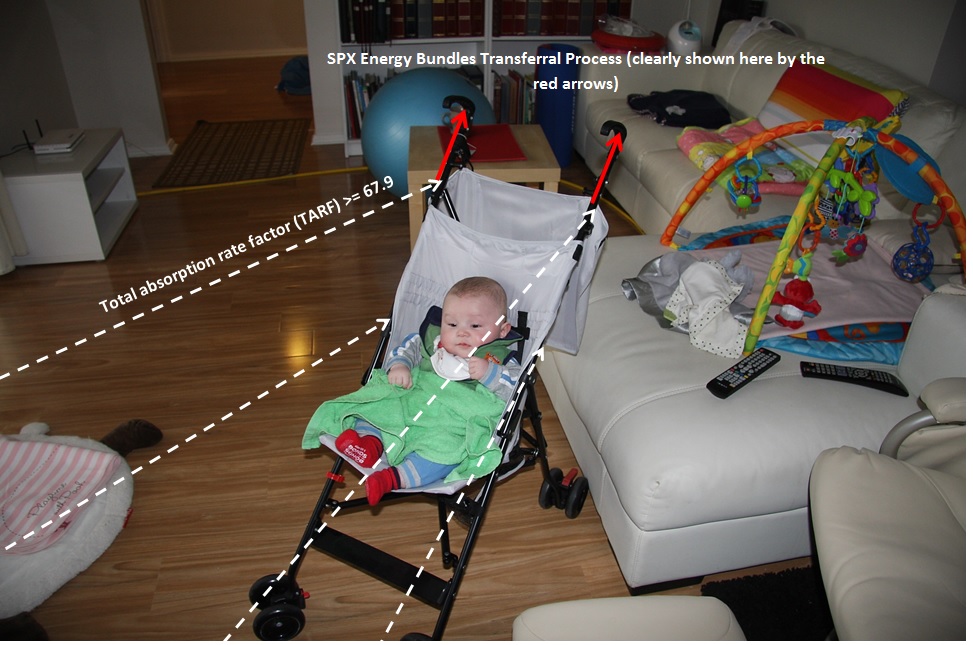
Under no circumstance should the subject’s head be less than 8.5 cm from the lowest point of the SPX Energy Bundle Flowlines
Which leads on to the importance of the machinery contained within the handles of the stroller. The text purports that the heart of the machine is contained within the curved handles and is known as the Audio/Visual Baby Translation Cortex Module, or AVBTCM for short. On ascertaining the importance of the handles, the students were careful to select a stroller with identical handle geometry as that portrayed in the blueprints. Because a secondary set of highly important electromagnetic radiation known as Ku Waves, otherwise known as IQY, or thinking waves, emanated downwards from the handles and longitudinally across the subject.
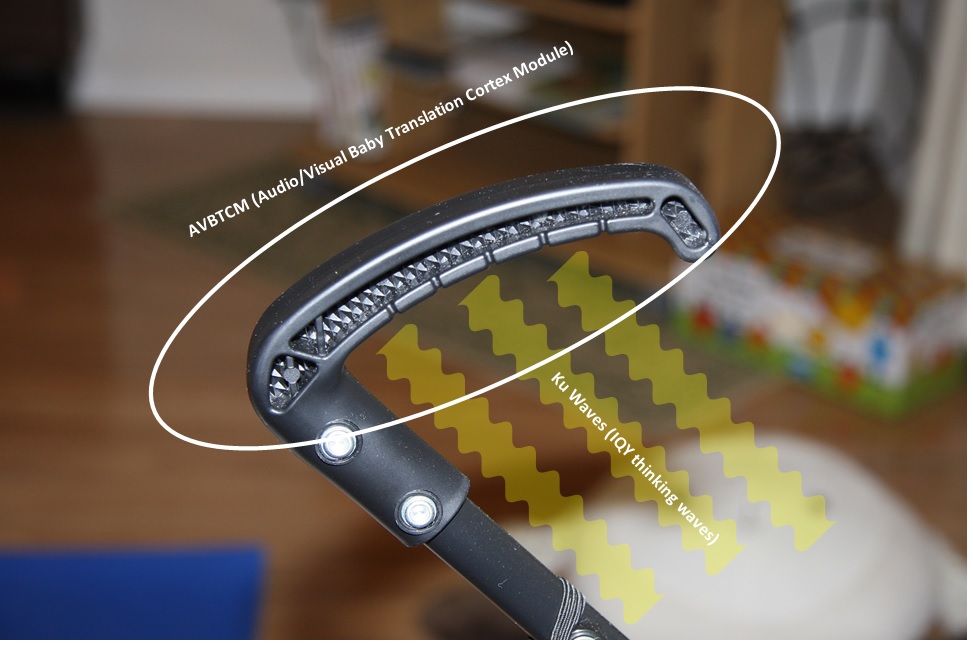
The diagram above clearly shows the inner working of the AVBTCM where vital Ku Waves are transmitted across the longitudinal path of the subject’s body.
Now imagine a sideways view of the infant sat in the stroller with the handles emanating Ku Waves down to the feet, and the subject’s head being central between the handles and the wheels of the stroller. The subject is sitting at an angle of approximately 45 degrees so picture a spot one metre away from the subject’s head facing perpendicular to the line of the body. This invisible spot is called the Wave Focal Reflector, or WFR, which collects energy transversely from the Ku Waves. It is then dispensed back to the subject in the form of a Delta Wave, which is Rapid Oscillation Baseline Assisted, an important feature not to be omitted. In essence, it is the intersection of Delta and Ku waves that form the crux of the apparatus whereby knowledge is transferred into the subject’s head.

Wideband delta waves are dissipated with specially adapted WFR (wave focal reflector) – although this is invisible to the naked eye. Intersection of delta and ku waves form the crux of the apparatus whereby knowledge is transferred into the subject’s head.
After twenty minutes of observing the subject watching a program about limes and apples, it was time to turn the DVD off and power down the chair of concentration.
The results speak for themselves.
Based on the repose of the face, it was clear that the infant possessed a superior understanding of the knowledge of fruit by using the chair of concentration for a mere twenty minutes.
Such a staggering discovery for the first day of April!

The results are obvious by examining the repose of the subject’s face.