Star Gazing, Restless Thoughts, and Rocket Man Syndrome

Shôn Ellerton, October 19, 2025
To gaze into the cold vast vault of the starry skies invokes feelings of wonderment, curiosity, amazement, and dread.
Here I am comfortably in front of a fire inside a remote log cabin in the wilderness.
It’s very early morning around 3am, the time many of us in our older years tend to wake up for no particularly good reason only to then fall back into the shadowy depths of dreamland. Apparently, there is a theory that this goes back to ancient times when we used to wake up to guard the fort.
It’s cosy inside the log cabin.
Earthy red and beige colours from the hanging Navajo Indian rugs complimenting the orange glow of the flames and the redness of the underlying embers further serves to accentuate the ambience of comfort.
Deciding to get some fresh air, I make my way outside. It’s frigidly cold with a slight breeze whistling through the pine trees, all but in inky blackness silhouetted against the brightly lit sky studded with stars, galaxies, planets, shooting stars, and the occasional man-made satellite.
There is no moon tonight.
I stand there to marvel at the sight. The stars seem infinite in number but most theories suggest that there is an actual limit.
Interestingly, I once read that there are roughly 1081 atoms in the observable universe. That’s a 1 followed by 81 zeros. That is a very big number and utterly incomprehensible to the human brain. To put that in perspective, the volume of water swallowed by a normal gulp, about 18 millilitres, contains 6.022 x 10²³ molecules, which if you were, instead, to spit it out into the ocean, every cup of water you extract from the ocean after a thorough mixing will probably contain about a thousand of those same molecules as you had in your mouth before spitting it out.
Despite once failing chemistry class, due to complete boredom, that number, 6.022 x 10²³ , has stuck to my mind like glue. It is Avogadro’s Number and represents the amount of anything to make one mole. Therefore, if you weigh up the water molecule with the atomic weights of two hydrogen and one oxygen, you get around 18g or 18 ml.
If there are only 1081 atoms in the universe, what’s the purpose of a googol, which is 10100 or, crazily enough, the googolplex, which is 10 to the power of a googol!
And during the time I’m marvelling at the stars, these odd mathematical concepts, some quite abstract in nature, churn around like invaders in my mind. Indeed, there have been philosophers and scientists determined to make sense of concepts which are so out of reach in terms of being reconcilable to the human mind, that some of them make it their lifetime obsession, often with catastrophic results.
Look no further than poor old Georg Cantor, a fascinating mathematician from the nineteenth century, who tried all his life to understand the concept of infinity amongst all his other important mathematical achievements. Arguably, he could be the foremost founder of how databases work as he developed the mathematical branch of set theory. Unfortunately, being a God-fearing man, trying to reconcile the mathematical principles of infinity in alignment with a higher power led him to be holed up in a sanatorium in which he died from a heart attack in the early 1900s.
Scientists who ponder over one problem doggedly for years often show signs of mental disorder being unable to move on to the next challenge until after solving that one problem. It is an unfortunate side effect for those who try to solve a problem rather than merely being fascinated by a problem.
I tend to fit in the camp of being absorbed and fascinated by a problem and simply content to let some other poor chap spend the rest of his living years trying to convert it into a mathematical solution. There’s so many other interesting things in the world to observe and not enough time.
I would say, guardedly, that most of our great scientists and mathematicians have been highly esoteric in nature, many of which have practiced what many call the ‘dark arts’.
Esotericism, occultism, magic, and the supernatural are often considered somewhat dark and mysterious in nature. Indeed, the very definition of occult is hidden and not satanic as many portray it to be. For example, a lighthouse sends out a unique series of flashing and occulting light to mark its identity.
Newton and Tesla instantly spring to mind as masters of esotericism. You would think that those ensconced in the world of the esoteric would be confined to philosophers, musicians, and artists. After all, aren’t scientists supposed to be logical and should only work on material which can be proven?
Absolutely not!
The world of pure analysis, validation, testing, peer review, and trying to prove something is correct or not really lies in the world of the technicians and the analysts. We need them, just as much in high importance, to balance and validate the discoveries made by the former lot, who tend to think out of the box to view the big picture but unchecked and left to their own devices, can get carried away down the rabbit hole.
This complete process is what I consider science to be. The necessary balance of undiscovered mysteries and validated discoveries which can be put to practical use.
Lastly, it is up to the ingenuities of the engineer to come up with the designs to make these discoveries practical to use.
And all this time, I thought about all these little things whilst looking at these bright stars.
I gaze at Polaris, the north star.
It’s not as easy as you think to find it unless you know how. I had to look it up.
Look for that great saucepan in the sky known as The Plough or Big Dipper. You can’t miss it! Then go to the vertical edge of the saucepan away from the handle bit. Go five lengths up, or down if the saucepan is upside down. There you will find Polaris, the Pole Star. As if by magic, this star is at the very end of the handle of the Little Dipper or Ursa Minor.
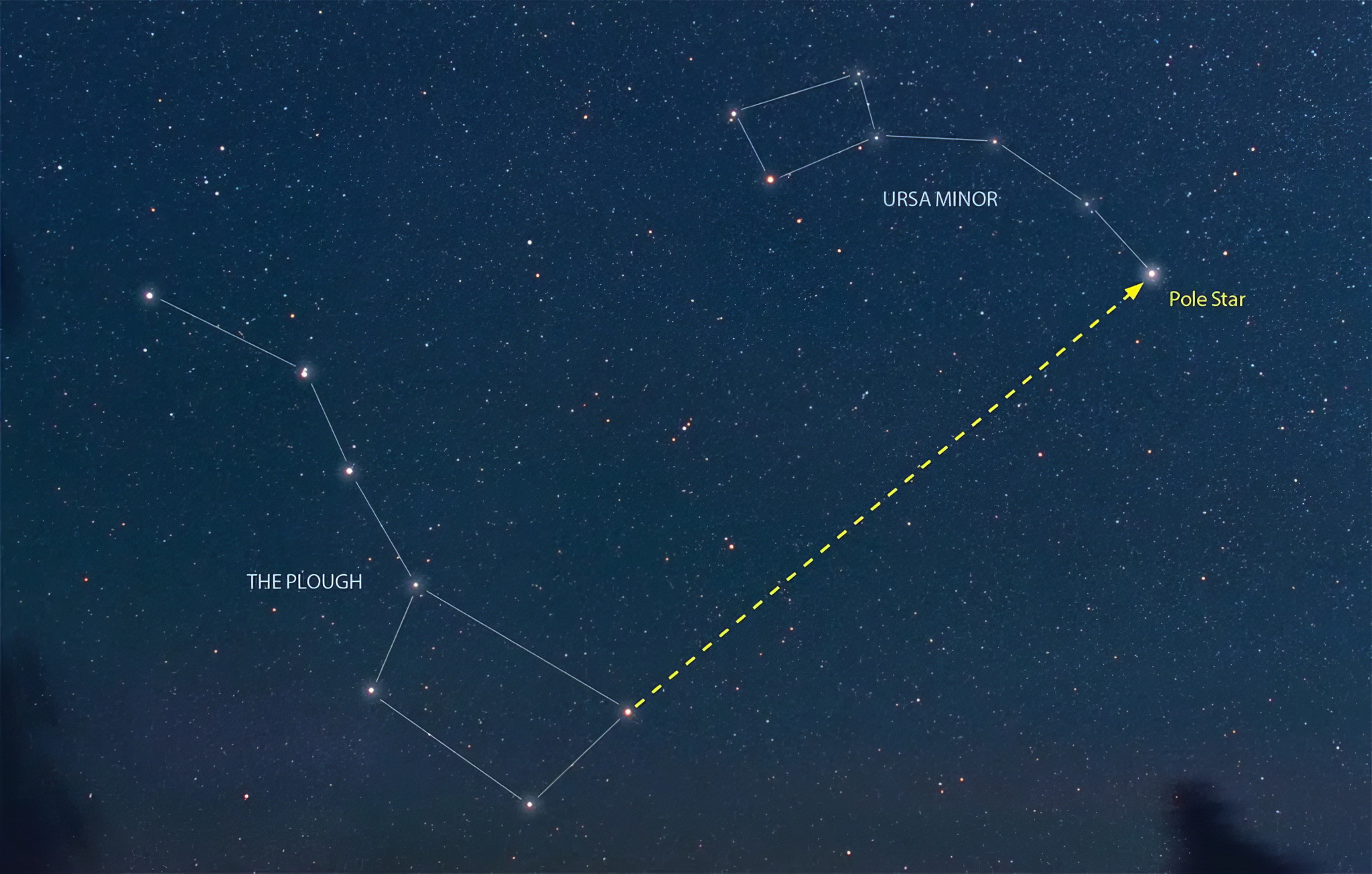
I have to deviate and complete the picture with respect to finding the south pole.
The southern skies, in my opinion, are even more mysterious.
There is nothing more profound in a lonely and haunting way to stare across the vast and hostile Southern Ocean trying to find south. There is no star to point you to south. It is a seemingly cold and blank void of nothingness. Although, the theory is that there could be a lot of so-called dark energy in its stead.
Finding south is more a geometrical problem than anything.
But first, you need to find two of the most prominent constellations in the southern hemisphere. The Southern Cross and the Pointer Stars. The Southern Cross is unmistakeable in its shape. It looks like a four-sided kite with the addition of a little fifth star just inside the perimeter. You can’t miss it.
The pointer stars are two very bright stars usually not far away from the Southern Cross and even easier to spot because there is nothing really visible between them to the naked eye. What makes the pointer stars interesting is that they comprise the stars, Alpha Centauri and Beta Centauri. Anyone interested in astronomy will know that Alpha Centauri is our closest star, bar from our own sun.
Just to add a few interesting facts.
Alpha Centauri is ‘only’ 4.3 light years away. In the grand scheme of things, this is a mere fraction of a fraction of a millimetre if compared to the size of the earth. And yet, 4.3 light years is rather difficult for us to comprehend for us mere mortals. Imagine going at the speed of light for 4.3 years. Well, that’s how far it is. Ever bearing in mind that light can travel around the circumference of the earth seven times in one second or takes eight minutes to get the Sun, that’s a crazy long way to go!
We, of course, reside in one of the outer arms of the Milky Way galaxy which contains perhaps up to 400 billion solar systems, each with its own star or stars. One can go somewhat crazy thinking about the distance to our next nearest galaxy, Andromeda, lying away from us at an incredible 2.5 million light years. Andromeda is certainly not the largest galaxy but it has more than twice the stars as the Milky Way.
And some way out to the mysterious edge of the Universe, a theoretical concept of course, lies such giant, bright, and outlandish celestial objects like quasars, pulsars, and other mystifying things. Quasars are genuinely scary objects being bright massive cores of galaxies powered by supermassive black holes just eager to swallow up and destroy anything in its path. It’s humbling to look into a telescope and realise that some of these quasars are hundreds of billions of light years away. This boggles me because I was taught that the Universe is ‘only’ 14 billion years old. But time is not linear in celestial mechanics, a concept so alien to our sublunary selves.
Let’s return to finding south.
It’s quite simple.
Draw an imaginary line segment between the Pointer Stars. Let’s be precise about this. Line segments have an actual length and lines are infinite in length.
Go halfway along the line segment between the two stars and then draw an imaginary line perpendicular to that line segment.
Now we have our first line in the sky.
Go to the Southern Cross and draw a line that crosses the stars at the top of the kite and the bottom of the kite, where a string would be attached if it were an actual kite.
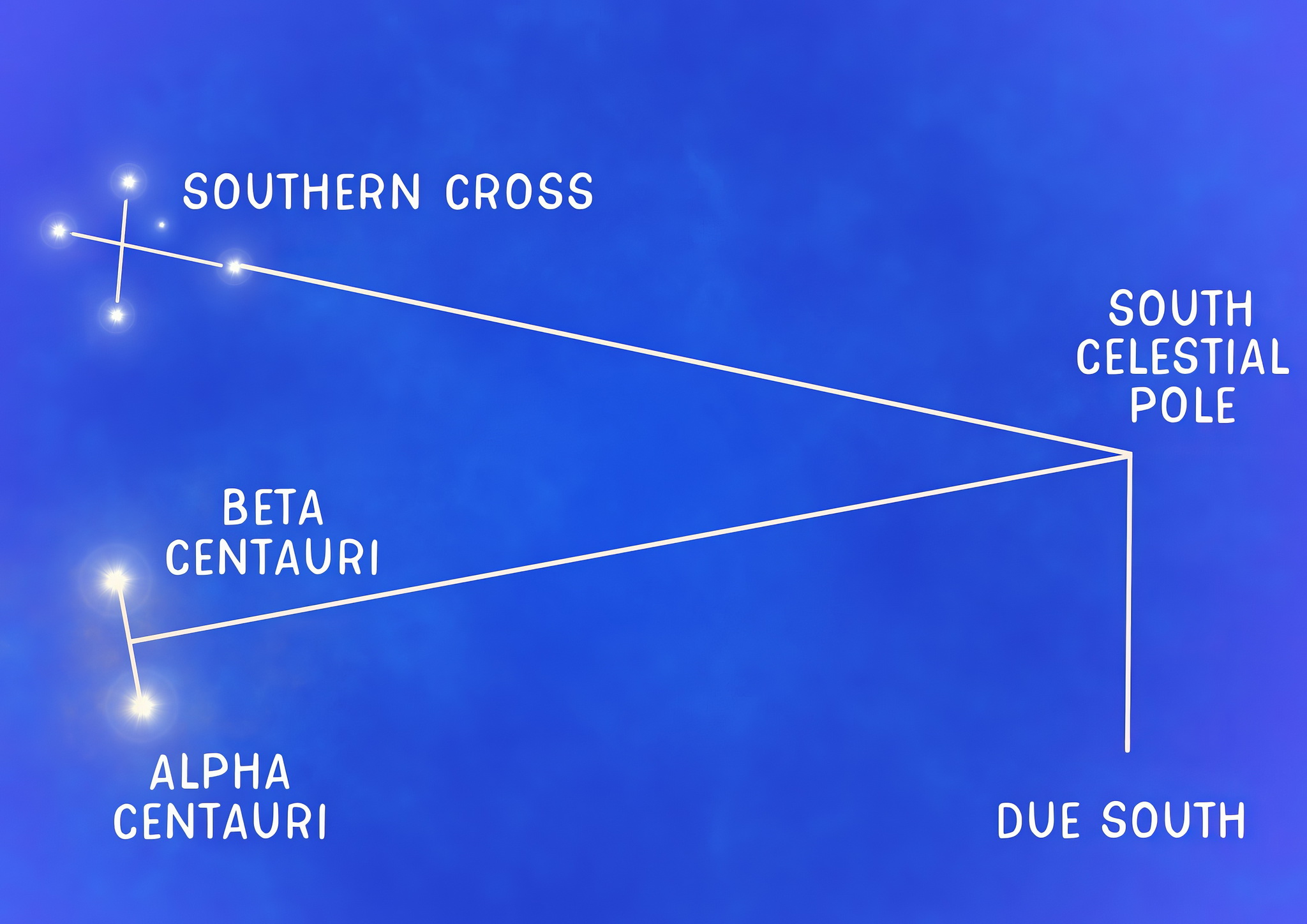
Now we have two lines in the sky.
Where those lines intersect is south!
Having satisfied myself that I can locate north and south using the stars, I then start to ponder on what it’s like to travel in some celestial rocket ship to get to these stars.
It’s unsettling to say the least.
Despite our yearning to venture out into the far reaches of our solar system, we are simply not designed to do so. Without being pessimistic, I am confident that humans will never venture beyond our own solar system let alone past the orbit of Mars. It’s a hostile and quite nasty place at best.
As beautiful as it is, being relatively close to Jupiter will fry your innards out with its intense radiation belt. Io, it’s nearest known moon is a hellish landscape dotted with thousands and thousands of active volcanoes because the moon is being torn apart internally with Jupiter’s monstrous waves of intense radiation.
Then I think about those courageous individuals who once spacewalked untethered using jetpacks or MMUs, Manned Manoeuvring Units. We started doing this back in 1984 but I, for the life of it, would never have done this, adventurous as I am in general. Imagine if you ran out of jet fuel or something hits you and pushes you the wrong way. You’d be floating out into space forever, or at least, until you get sucked into a large object like a planet or a star.
And nothing. Nothing could save you unless someone else had a MMU to hand to rescue you. You’d just run out of oxygen and die.
Apparently, that dangerous practice has been discontinued for quite obvious reasons.
Staring out at the starry night is also eery because there is really very little between you and that star based on the slightest probability that another lesser object like a planet or asteroid, invisible to the naked eye, passes between.
Science fiction writers have inspired human imagination on space travel for more than a hundred years. Rocket ships that can take ordinary passengers to remote and exotic planets which are atmospherically liveable.
The writer, Ray Bradbury, in my opinion, really struck an emotional chord with respect to space travel. Although he was more famous for his Martian Chronicles and Fahrenheit 451 pieces, he wrote numerous short stories which are of far more interest to me.
He came up with a profoundly lonely and melancholic sci-fi story called The Rocket Man. A story of a rocket man who went back and forth from Earth to some other planet to do, I guess, important business for some future space federation.
The crux of the story is not so much about the space travel or, indeed, any of the destinations he went to. It was about the aching longing experienced by his wife and son who watched him come home only to then dash off again to the stars again.
For the first couple of days he came home, he was happy. He did things with his son and wife. She cooked for him. The son told him about his achievements at school. But after a couple of days, he would stare to the stars at night hollow with emotion and longing to get back.
Naturally, after being away, he was yearning to come back home to see his wife and son.
This disheartening situation I like to refer to as Rocket Man Syndrome. The feeling of never being really happy in one place and always having to go somewhere else.
In the story, to mitigate these sad and emotional feelings, his wife already assumed him dead because one of these days, he’d likely perish into the ‘great aether’ of the Universe.
Rocket Man Syndrome exists with us today in the form of those who work remotely on and off. The so-called FIFO, or fly in and flow out crowd. For example, offshore oil rigs, international business travel and roadshows, and doing work in remote areas of the planet.
I’ve been a victim of this for quite a lot of my career. The excitement of flying out to new and amazing destinations for work, which, in my case was in the world of telecommunications. When I was single, it was not really problematic, but when you have family, it becomes quite a bit harder. Thankfully, we have access to video communications but it is not the same as being in person with those you love and cherish. Many relationships are very much strained in this way and I certainly advise anyone living with a family to take the FIFO experience very seriously.
Bradbury’s story, of course, is taking the concept to its extreme with interstellar travel, but the concept of Rocket Man Syndrome is real. Today’s Rocket Men equivalents, or those who work in the FIFO space for many years, often gradually succumb to the numbness of not being entirely settled and satisfied being where they are in the present but always looking forward to returning to the place where they just came from. Unless the FIFO job is a crappy one, of course!
The stars have so much to tell. It opens our mind in more ways than one.
The stars are not simply beautiful objects that light up the sky. They look down on us and prod our minds opening up every conceivable question which we haven’t yet answered.
I’ve grown cold standing outside and repair back to the comforts of the warm log cabin and attempt to go back to sleep.
But, alas, I cannot…