I’m Sick to Death of Catering to People with Food Allergies
Shôn Ellerton, January 9, 2026
I’ve never come across so many people with food allergies and dislikes as I have in Australia. And I’m sick to death of having to cater for them!
I like to host and cook for others, but, gee whiz, the minefield of allergies to a myriad of foodstuffs and, just general pickiness, can make it such a chore to decide what to cook.
Interestingly, and somewhat annoyingly, Australia has the highest population percentage of any nation which is allergic to some sort of food, at around, 7 percent. And that doesn’t take into consideration another 10 to 20 percent who think they are allergic to some food but turning out to be food which they simply don’t like.
For example, I have a mother-in-law who won’t eat beef and lamb because the taste is too strong for her. She’s fine with pork and chicken, though. Which means having to make spaghetti bolognaise, a dish my son loves, without the beef but making it separately and leaving it on the side.
Essentially, this is a spaghetti arrabbiata, but that’s not accurate either because I have to leave out the chili!
I love chili and all that spiciness but, without any shadow of a doubt, I am the minority in all those I cook for, which includes my friends and family. I cook a lot of Indian and Middle Eastern cuisine and I love to add plenty of flavoursome spices including a bit of spiciness, but the problem is that, what I consider to be mild in spice, is infernal for others.
The problem is not simply solved by adding in the chili after, because when the chili cooks with the food, its spices and aroma is infused throughout. Adding in chili later individually is just not the same. The aromas aren’t there and you have to add in considerably more to get the same kick.
I always joke around those who’re struggling with chili spice by saying things like
‘The chili will make you live longer by killing all the bad bugs.’
Or, and only to my son and his friends,
‘It’ll grow hairs on your chest!’
Perhaps chili is good for you, I don’t know.
Back to allergies, we have a whole list of foods which seem to get the attention of the food-intolerant.
I know a couple of people who say they’re allergic to fish. Not necessarily seafood as they’re fine with shellfish including crabs and lobsters. Not that I’m going to shell out, pardon the pun, exorbitant amounts of money to eat a regal creature that can live up to 100 years in age.
Then, of course, there is the reverse.
Those who are allergic to shellfish but not fish!
I have a couple of friends who absolutely refuse to eat any seafood at all, one of them, positing that anything that remains below the surface of the water should stay below the surface being not fit for human consumption.
I tend to eat what I’m given, or at least try it if I’m not familiar with it or it doesn’t look appetising. However, I struggle with fish with infinitesimally small bones because extracting the flesh from its bones with my tongue is virtually impossible, unless you’re an Asian. Having once choked on a small salmon bone, I have a bit of a phobia of eating fish with tiny bones. The other food phobia I have is eating a peach whole because, having once chipped my tooth on something unexpectedly hard and having to get it capped, I fear of losing my cap to a peach stone.
Basically, serving seafood to a bunch of guests is hit and miss. And it’s expensive, and seafood leftovers are kind of gross in my opinion.
Most of my cooking involves meat of some kind, although I often do a vegetarian dish as an option, especially if it’s Indian, Mexican or Chinese cuisine. But vegetarian dishes need lots of flavours to overcome its, often, native and relative blandness to meat. Chili does a world of wonders, but then you’ve got the spice wimps to deal with.
Chicken is often the go-to, because I know of no religious group of people who refuse to eat chicken. But chicken is all too pervasive at times and just a bit boring when in excess. Moreover, I’ve come across people who will eat any other meat except chicken!
Veering off a bit, there’s a fascinating account of Katharine Birbalsingh, dubbed as Britain’s Strictest Headmistress, who presided over a successful school in inner London. Instead of preaching the tenets of multiculturalism, diversity, and inclusion, she opted for multi-ethnicity, nationalism, and meritocracy. To overcome the problem of religious differences between kids, she disallowed praying in the school and provided only vegetarian meals. She got enormous praise from the parents, most of whom are Indian and Asian background, by delivering some of the best results from all of Britain’s state schools. She was hated by the progressive and racially-biased left of course when white middle-class moms from suburban London who had nothing to do with the school came down to protest against her claiming that she is a right-wing racist. They were even more infuriated because the headmistress, herself, was from a minority group!
Which leads me nicely into the world of vegetarianism.
Safe bet as food to serve to a bunch of people?
Nope.
One of my wife’s friends, from no fault of her own, is allergic to gluten making it notoriously difficult to cook up delicious pasta-based meals, or anything that involves wheat.
Gluten-free flour is disappointing to work with and doesn’t taste the same or feel the same. It’s basically flour with all of its sex drive taken away from it. A soft and unappealing texture with no stiffness to it.
Preparing meat-free and gluten-free food invariably turns out to be something either Indian or Mexican in my cooking armoury. Whether it’s corn-based soft tacos or one of my dhals, they tend to satisfy most.
But then we have those who allergic to peanuts and nuts.
So, I’ve cooked up a lamb and rice dish with cranberries and almonds only to realise that I’ve added a problematic ingredient to my dish.
Nuts. The almonds.
Why are so many people in Australia intolerant to so many foods?
My wife, who comes from China, would have found it almost inconceivable during her days in school to have come across anyone with an allergic reaction to some food or another. They just don’t have people in China who are allergic to food. Or very rarely.
So why is this?
Is it because we don’t expose kids to a wider variety of foods which may be considered allergenic? Is it because we live in an ultra-clean environment where the presence of any new germ we encounter isn’t given a strong fight by our immune system?
My wife and I were talking about this and we both agree that catering for all these food allergies is, not only exhausting, but quite ridiculous.
I was reading a Conversation article the other day highlighting that Australia is one of the few places in the world in high-income societies that schoolkids are not provided with hot meals at the school. Despite praise in the article citing the benefits of having hot school lunches, even in the UK, there were so many whingy comments on its Facebook post by Karen-type Australians stating that too many kids would suffer because of food allergies.
Give me a god-damned break! Seriously!
Again, another example. My son has a friend who sometimes comes over for a sleepover. But apparently, he is not allowed any dairy products by his mother, which is a royal pain in the ass at times.
I’m not suggesting in any way that drinking cow’s milk is ideal for any adult, but all this fake butter stuff like vegetable spreads, olive oil spreads, margarine, and drinking all those alternative ‘milks’ like soy, almond, and oat milk has got completely out of hand. And, by the way, those manufacturing this rubbish are absolutely rolling in it!
Going back a few decades at the local village shop, there was only full-fat milk, butter, and actual cream. None of that alternative crap which tastes pretty darned awful at the best of times.
So far, we have discussed those who are intolerant, allergic, or just don’t like certain foods.
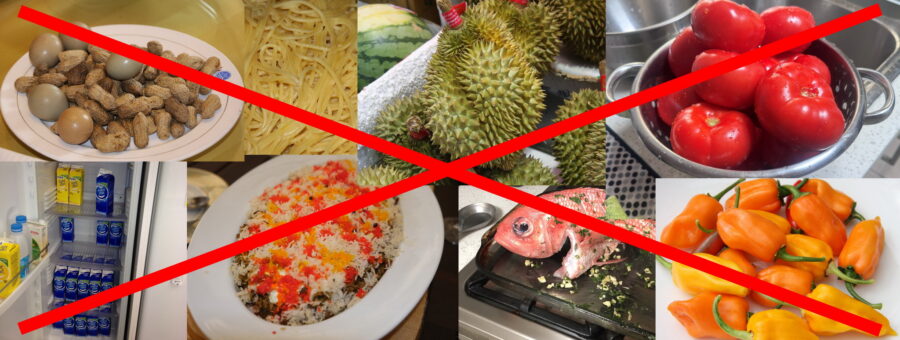
Meat, dairy, nuts, fish, shellfish, chicken, wheat, pork, beef, peanuts, and chili.
And there’s more!
Those who don’t like tropical fruit, my mother being one. Pineapple is her ultimate nemesis! If she detects even one whiff of pineapple in measurements of a few parts per million, she will freak out.
This isn’t quite so debilitating when trying to put up a meal for a group of people because tropical fruit is seldom used in main dishes, except, perhaps, coconut for some curry dishes or in Caribbean-style cooking which sometimes uses a variety of other tropical fruits.
I have a sister who finds any kind of mushroom the devil’s food, so making something like a beef wellington is clearly out of the question. Mind you, I do understand the fuss with mushrooms, because, let’s face it, they are a member of the fungi family and some of them are horribly nasty and fatal when eaten.
There is also one particular herb which is truly disgusting for some. And that is coriander, otherwise known as cilantro in the United States. Apparently, it comes off as the taste of soap to some, so beware serving up those Asian dishes!
The latest one I encountered is a friend of ours who doesn’t like tomatoes.
That’s fine. I don’t particularly like tomatoes, as in eating raw tomatoes. However, he won’t eat anything which has tomatoes in it making it very difficult with much of Western food, which often uses a variety of tomato-based sauces.
My late father, knowing that I don’t like eating tomatoes, used to reply to me that tomatoes are simply too modern for me.
Never understood why he said that!
He hated rice as it reminded him of very badly done soggy rice during his schoolhouse days in England. And being reminded of being given toilet swirlies by classroom bullies! Mind you, he didn’t like pasta either as he considered it to be bland and tasteless. In his words, the only use for pasta is that it’s the perfect mechanism for eating melted cheese, which he ate in quite large amounts.
My late grandfather hated hard-boiled eggs, which I can relate to having had cold hard-boiled eggs on picnic outings which had gone green, dry and fluffy from being overcooked making them the perfect substance to induce that choking sensation.
Sure, it’s perfectly okay to dislike certain foods.
I, for example, don’t like pickled and fermented things very much. This includes pickled beetroot, rollmops, pickled onions, and sauerkraut. Fermented things are a no-go in my book, especially when they’ll likely to explode out of their tins like surströmming, which is fermented herring popular with Scandinavians, who tend to eat weird things like salty candy, sweet cheese, and fishy things that move on their own accord. I’m also not fond of most condiments people use to embellish their hamburgers, hotdogs and sandwiches which include tomato ketchup, mustard and chutney.
Avoiding major food ingredients like rice, flour, dairy products, meat, and tomatoes gets quite difficult when it comes to cooking for a lot of people.
Now, there are the vegetarians and vegans who refuse to eat meat or eat any substance made by animals because they think its unethical.
In general, I find, to be in company with ethical vegetarians, vegans and teetotallers, or those who abstain from any alcohol, excruciatingly boring. So, I tend not to invite them!
And finally, what to serve up to a group of people that anyone can eat without putting up a protest?
If you want a menu which doesn’t incorporate wheat, rice, meat of any description, tomatoes, dairy products, eggs, seafood, and nuts, then you’ll invariably get the usual boring suspects which include dhal, mixed vegetables, salad, vegetarian chili, and shudder the thought, sticks of celery and carrots.
Trust me.
I, and most other red-blooded men, won’t be going to that rabbit feast.
I’m over it.
Unless I’m inviting one person, a couple, or one family, of which one of them has a food allergy or an aversion to a particular food I’m aware of, I say, bugger it!
For a larger group of people, whatever I cook, I’ll state the ingredients before serving up and if someone doesn’t like the food or has an allergy to something in it, I just hope there’s something else on the table to eat.
Otherwise.
Tough!