Kids Need More Dangerous Playgrounds To Feel Alive!
Shôn Ellerton, February 18, 2026
We can’t cocoon our kids in an ultra-safe environment anymore. We need our kids to sense being alive with more challenging environments.
We need danger to feel alive.
Furthermore, we need danger to keep a healthy state of mind.
I posit to suggest that many of today’s mental illnesses stem from being in a society in which there is an overemphasis on mitigating risks from activities which are classified as being dangerous.
It all starts with childhood. And it starts in the playground.
For those of us that have children, we can’t imagine anything worse than being in the situation in which our kids get up to no good and become victims of an accident that could have been prevented. But we need to let go to some degree, because if our kids become cocooned in an overly safe world in which every possible measure is put in place to avoid an accident, they will suffer far more when such an occurrence does happen when compared to those kids who experience danger on a far more regular basis.
Playground experience is, perhaps, one of the most important origins of how kids learn that ‘danger is around the corner’ if the playground is not respected. Being an 80s kid myself, I certainly remember me ‘abusing’ playground apparatus such as flinging myself off swings during full motion or trying to walk on top of one of those geodesic grid half-domes without using my arms only to fall off unceremoniously and land on the pebbly ground underneath.
We didn’t have those soft spongy material padding back in those days!
When you fell on the playground. It bloody well hurt!
But during the 90s, something happened in many countries of the Western World. I’ll say now that those countries not in the Western World didn’t dilly and dally about with trying to overly mitigate the risk of playground accidents. During the 90s, playground design got so incredibly boring because they were designed to be accident-free. There were plastic slides which were, at best, a couple metres in length. Soft springform rubbery surfaces which made impact on the ground risk-free. There was nothing more than 2 metres in height, if even that.
These playgrounds of the 90s were boring and no kids, except perhaps preschoolers and toddlers, wanted to use them.
Australian playground designers during the 2010s became a little more savvy with all this and started to build some wonderful playground facilities for kids. But it took almost two decades to realise this.
Sure, they still used that modern spongy surface, however, they learnt that building playgrounds suited only to toddlers and preschoolers is not the way to go. I think today’s Australian playgrounds are not half-bad at all. We’ve now got some amazing playgrounds.
Some of today’s Australian new playgrounds are quite challenging to say the least. And believe me, if you do something stupid or exceptionally clumsy, you could certainly be in a little world of hurt. However, some of these playground designs are so clever that if an accident did happen, the chance of a real injury of fatality is extremely unlikely.
However, it’s going to hurt!
And that’s the point. Where there is risk, there is reward. No child will find any adventure in a playground in which there is total safety.
Australia, in my opinion, has some of the best public parks and playgrounds I’ve come across on the planet. They’re clean. They have free barbecue facilities. They’re seldom busy. Australian children have the best access to playgrounds.
In Adelaide, we have quite a few new playgrounds which, not only look real nice and blend with the environment, but genuinely difficult to conquer without having that wobbly-knee reaction when you’re just a little too high off the ground.
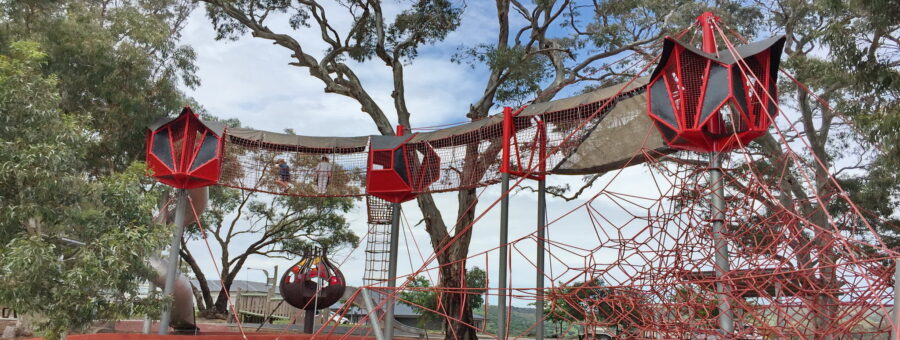
Australia has rigid codes of practice in practically everything we build including playgrounds. But some of the architects who came up with these playground designs managed to create some quite scary obstacles. Not far from us is such a playground with a lattice net structure reaching quite high, something in the order of six to eight metres. Now you may think that a mere six to eight metres isn’t high, but actually, this is about the same height as a double-storey house. Tradesmen have fallen to injury with such heights quite frequently.
During the 90s, the fear of litigation because of an injury on the playground was so acute, that playground design was such that no kids with any adventurous spirit would want to use them.
Thankfully, that had changed.
We want our children to be challenged at the playground.
We want them to be scared at going higher on the obstacle.
We want our children to be adventurous.
However, we can only achieve this, if there is that element of danger. However, today’s technology has made this safer without encumbering the perceived danger of the obstacle.
And that’s what counts!
In Australia today, we have playgrounds that many adults wouldn’t even attempt to climb.
I’m not kidding!
And when I see young kids proudly reaching the top of a six to eight metre rope pyramid structure, I applause, not only the kids, but those designers and those who accepted the playground design despite the helicopter wowser lot who keep trying to thwart these efforts on grounds of being too dangerous.
Kids need challenges.
Kids need an element of danger. If something doesn’t work, like slipping off the rope, or falling down, it is going to hurt.
I think that serious playgrounds for kids contribute enormously for their future resilience in life and how they interact with others in the professional world when they enter their stage of being in a career.
Playgrounds, of course, are not the only way to teach this kind of resilience. For example, there is an amazing world of urban exploration, a topic very much beholden to my heart when I was a youngster. Challenging sports, whether it be team-based or solo-based. And, of course, unusual travel experiences which involve considerable risk,
To conclude, there are many ways to promote danger and well-being to our healthy mental state of mind, but as a starting point, the first thing to do is to ensure that our playgrounds have enough danger, or at least, perceived danger element so that our kids can develop a real resistance to some of the modern mental illnesses which are becoming too common in our Western World.